Surprises and aliens
Posted on May 26, 2008
Filed Under Uncategorized | Leave a Comment
After being away for 12 weeks over the past four months, it is good to be home for a while.
After voting in the advance poll, I was out of the province during the municipal elections.
Arriving home, I find the general reaction to be the same as my own. We are a bit surprised and pleased with ourselves to find we collectively elected a council that may be half sensible.
That does not mean we think they will or that we want them to all think alike. That is the worst type of government for the people.
We do think they may have our interests at heart and not be driven by strange personal agendas or parochial prejudices.
We do think they appear to be people who can listen as well as talk and may combine their ideas for better solutions and results.
Many of us like the fact that we elected a Francophone, bilingual mayor. That should make it obvious to our neighbours that we are not the gang of rednecks we sometimes appeared to be.
Crisis after crisis
The history of the Miramichi is just one damn crisis after another. Our new council comes to office as our traditional economy is a shipwreck.
Most of our challenges are not municipal issues. Still council will need imagination, vision and courage to encourage and support developments that fit the future. Trying to return to the past is not an option although it is tempting to tell voters it is.
A prime example on a larger scene was the call by US presidential candidates, Hillary Clinton and John McCain, to give Americans a gasoline tax holiday for the summer. Anyone with a hint of a clue knows that would be pouring gasoline on the flames of the problem. Sadly but truly the solution to high gasoline prices is high gasoline prices. It is high prices that will lead to the innovation needed to escape our oil addiction.
Barack Obama, the odds on winner of the Democratic party nomination, showed true leadership by not saying the easy and popular thing but the right thing.
Our city council could provide some similar proper leadership by looking for a waste transfer station within the city limits. The cost and waste of simply hauling all of our waste to Red Pine is getting more ridiculous by the day.
I realize waste management is the responsibility of the Northumberland Solid Waste Commission but its board would ecstatically welcome an offer of a site.
Let us hope our new council lives up to our hopes. For one thing, that will make more good candidates in future willing to offer and serve.
Aliens are among us!
This generation of kids are no good. Everyone knows that. In fact, everyone has known it since it was first mentioned some 6,000 years ago.
It is just as true now as it was then.
This generation are a bunch of shallow slackers modeling themselves after Paris Hilton and who are slaves to Facebook and computer games with computer generated special effects.
They pay no attention to teachers and suffer no consequences.
Knowing that, we must surely conclude it is aliens from other worlds who put on shows like “Seussical The Musical” at James M Hill this past week.
Surely there is no way our own youth could have put on such a mind-blowing extravaganza. Slackers could not, would not, possibly put in the hours and effort necessary to turn the local stage into a whirling kaleidoscope of song, dance, colour and inspiration.
Most of the problems with hopeless kids, of course, are teachers just going through the motion for their summer vacations and pensions and parents who set no good examples.
Director David Gopee doesn’t even look Irish and those costumes could never have been brought to reality by local volunteers.
Unless, of course, the slander we hear about kids, teachers and parents is just careless babble.
In fact, the local drama scene is like the National Hockey League. It is a chapter in a long, exciting history that just keeps getting better.
There were parents, grandparents and great grandparents in the audience who once performed on the local stages.
They know the deep emotions, joy and grief this year’s kids felt as they ended a co-operative triumph.
The triumph is repeated throughout the community. Eel Ground school continues to rack up provincial and national awards for their important productions.
Seeing the brilliance and energy of this generation, one is reassured that Miramichiers will find a way to keep the community alive and moving into the future.
Wellington, New Zealand
Posted on May 26, 2008
Filed Under Commentary, Travel, Uncategorized | Leave a Comment
From Napier, we drove down to Wellington, New Zealand’s capitol, at the bottom of the South Island.
On the way, we got further reminders of just how empty most of New Zealand is. Like Canada, it is getting emptier. People are abandoning the smallest communities. We stopped in one rusting, rotting, flaking little crossroads community where almost half the commercial buildings seemed empty. In a combination general store and ice cream stand, there were three employees on hand although I don’t think they were all on duty.
None of them had any idea what the population of the community might be. On the upside, they had maple walnut ice cream, my favourite and hard to find in these days of neon-coloured flavours.
Wellington is a delightful city although already getting far enough south to make us summer pilgrims nervous. Because we had the car, we had a hotel far enough up the hill to make our town excursions part of our fitness program. Wellington, too, is one of those cities where roads that intersect do not necessarily connect. There is our street down there but there seems no way to get to it.
The main street to our hotel suddenly became one-way heading toward us.
The city itself is delightful with several of the very finest Maori art galleries in the country. Intricate carved masked and deep, deep or translucent greenstone (jade) jewelery went far beyond craft to individual art.
We didn’t take the Parliament buildings tour which everyone praises but we did spend an entire day in the brilliant Te Papa museum. It covers all of New Zealand history, warts and all with an insouciance that tells you New Zealand as a nation is comfortable in its own skin.
There is a video called “Golden Days” that shows a farmed deer being slaughtered and the Neil Armstrong moon landing with a New Zealand flag being planted. It also shows film of forest being burned to clear land.
Canada resents having larger nations ignore our sovereignty. We have little to complain about compared to New Zealand.
The French secret service sank “The Rainbow Warrior” in Auckland harbour killing a crew member. The Greenpeace vessel had been protesting French nuclear tests on a Pacific atoll.
The Kiwis caught the two agents responsible for the sinking and convicted them in court. Then they allowed France to take the agents back to serve their lengthy sentences at home. Two years later, both agents were free and one had become pregnant while, theoretically at least, in prison.
The Americans gave New Zealand a very hard time when the little country declared itself nuclear free and refused to allow nuclear-powered vessels to dock there. The US pressure culminated in a debate between the New Zealand prime minister of the day and the erudite American conservative William F. Buckley Jr. Everyone expected the Kiwi PM to be humiliated. He was not. He pointed out that the sanctions the US was imposing on New Zealand were more in keeping with the totalitarianism the allied nations were supposed to be opposing.
New Zealand also suffered tremendous trade setbacks when the UK joined the European Economic Community in 1972 and New Zealand lost its favoured access to UK markets.
Fortunately, Asia quickly made up the deficit.
CBC logo
We were surprised to encounter the CBC logo in a different colour on a business in Wellington. Its name is “Imbibe.” I have no idea what it does.
Nuke the Snowbirds!
Posted on April 20, 2008
Filed Under Commentary, Travel | Leave a Comment
So, I’m in the pool at the Gulfport, Florida, condo complex where I’m visiting Miramichi friends John and Joyce LeBlanc.
A bunch of elderly women are gossiping and teasing each other. One of them says to another “So, you are leaving Monday?”
“Yes, I think so,” is the reply.
“No, no! I don’t want this ‘think so,’ ” says the first. “Last year we threw you the big going away party. Then I come down the next day and there you are in the pool.
“I’m throwing you a party Sunday night. You’d better be gone Monday!”
Then came the line that cracked me up.
“I’m bringing my CD ‘If It Is Snowbird Season, Why Can’t We Shoot ‘Em?’ ”
Gulfport is a somewhat seedy old Florida community pretty much engulfed by St. Petersburg. It used to be a fishing port and a biker town. Now it is home for all or part of the year to a large number of geezers.
It looks like I imagine Key West did 40 years ago. There are lots of funky little cafes, restaurants, bars and art shops on streets running up from the beach. There are entertainments almost every night. The city and chamber of commerce run a free trolley bus service on Friday and Saturday nights from six p.m. to 10 p.m.
The local rec centre and library offer everything from free computer access to courses in computers, photography, yoga, tai chi, philosophical discussions on the six questions posed by Socrates to his students and just about anything some expert may have retired from.
So far, I love it.
I’m in one of many buildings in a complex known as Town Shores. Built in the early 1970’s they are rugged if not elegant. Nine of them look out onto Tampa Bay or to lagoons cut in from the bay.
Each of the buildings has its own condo committee aka politburo. They each have their own rules that vary in number and degree of severity. In some, for example, you cannot replace carpet with tile or hardwood lest you disturb your downstairs neighbour. You cannot go into the pools at night after eight p.m.
In the building John and Joyce are in, natural gas for cooking is included in the rent. Electricity has run from $19 to $25 per month. For less than $50 per month, tenants can have local and all North American long distance, dozens of TV and music channels, including a personal video recorder, and high speed internet access.
Buy or rent?
The condos themselves vary tremendously in interior décor. Some owners have invested a lot, some very little. As a result, when they come on the market, as they regularly do given the average age of owners, they range in price from as little as $100,000 to perhaps $300,000.
Currently, they are a lousy investment. After condo fees, insurance, taxes, repairs and maintenance, you could not rent out for enough to match what your investment would generate in a GIC. In other words, it is cheaper to rent than to own.
Realtors, of course, are confident prices will soon resume their rise and rental costs will escalate along with them. Of course, realtors always feel that way. They are also, of course, usually right. The question always is money or property will generate the best return.
The consensus among people I have spoken to is that prices have not yet bottomed.
City access
One of the very nice things about Gulfport is its proximity to St. Petersburg. It is roughly akin to living in Nelson and Douglastown being Halifax.
Boomer favourite entertainers come to St. Petersburg regularly. Right now the radio stations are talking about Chicago, The Eagles, Santana, Steve Miller, Joe Cocker, Bruce Springstein and the like who are or just were or will be here.
Moguls, tycoons and titans who retire here, came from here, or have vacation properties here have been stupendously generous in sponsoring galleries, theatres, auditoriums, symphonies and theatre companies.
We went two and a half hours south, to Naples, to visit family and an old friend. The local art gallery had a magnificent Picasso exhibition curated by their own staff.
A notable thing about the cultural scene is the number of expert volunteers. You have the sense that the tottery greeter at the gallery door may well have been a fine arts teacher before retiring to Florida.
On the way back, we stopped at a huge outlet mall near Bradenton. I was in a golf store when, as always happens abroad, the Miramichi connection popped up. This time it was Murray Lepard.
Wildlife and wild life
It is sexy spring here. I’ve already seen a family of ducks and have a picture of two brand new ducklings studying the giant John LeBlanc.
A Muscovy duck mother hatched her eggs at the foot of the stairs we use. She is a member of an ugly tribe. Muscovies look a bit like overgrown gulls with mottled dark and white plumage, scruffy white heads and eyes ringed so red they always look like they are coming off the second week of deer camp or four consecutive Bay du Vin survival weekends.
No one could give her lessons in maternal devotion though. She did not move from the nest from the time I arrived until we watched as the eggs hatched. Within hours, she and her chicks were gone. She must have been starving. She did accept a little water but very little food while she was on the nest. Perhaps, in the wild, they don’t want to attract any attention to their presence and we all know what eating leads to.
The Egrets, Herons, Ibises, Pelicans and dozens of birds I don’t know fish and fly and shriek in wonderful numbers. Dolphins patrol the lagoon outside the window where John, Joyce, and now I, sit in the morning and evening watching the sun rise and set. Cute little lizards scurry and freeze, scurry and freeze everywhere from hedges and poles to the walls of outdoor bars.
Even in geezer world, there are young people. In fact immigrants from all over the world flock here for tourism jobs. You see them on the beaches on the weekends making do with a couple of handkerchiefs for bathing attire.
Still, most of the flesh you see most days is an excellent argument for seriously reconsidering any youthful affection for tattoos.
Mind you, some of the people inside these sagging hides have delightful minds and attitudes.
Bobby Watson rides his tricycle to the Gulfport beach each day to practice his saxophone. He plays gigs with bands all around the area. He says he plays rhythm and blues now because he doesn’t want to think enough for jazz.
He has an apartment in Kentucky, near his family, a cottage on a lake in Maine and a trailer in Gulfport. He is having so much fun he can hardly stand it.
The very tidy and sparkling woman who waits tables at the Water Witch café on the waterfront lives on a 27 foot Hunter sailboat in the harbour. She rows ashore with her little Peugot bike in her dingy. She sails up and down the coast to wherever the tourists are to pick up waiter work. With the season winding down here, she is ready to head north but her employer is pressing her to stay.
On the local entertainment scene, with my usual stunning luck, we went to a local plaza (in the tiny village square meaning of the word) where there are different musicians playing and, or, jamming most nights.
On Friday night, Chucky Love was playing for the very first time publicly with a new side woman, Brittany D. Friesen.
Chucky is not the lounge lizard you might expect from the name. He is a political science major at the University of South Florida and writes almost all of the songs he performs. They are strong, literate social commentary delivered with powerful emotion and an aggressive acoustic guitar style that makes his thumb bleed.
He has one song called “I Don’t Want Your Monkey,” that is about not wanting you to put your hang-ups on his back. It includes the brilliant term “Freudian flatulence.”
Brittany is a gorgeous blond Rodin would have been compelled to sculpt sitting on her stool with angled legs and hair down over her closed eyes and expressive face as she improvises on her electric violin like The Rapids’ Ryan Keenan does on his guitar.
Damn! I’d like to hear them together too!
The pairing was so new, they didn’t even have a mike for her vocal accompaniments but their sound was superior to many groups I have heard with a techie at the controls.
Her violin soared and reeled and writhed up and down with every emotion, tone and rising and falling volume in Love’s songs.
One of the three songs he (they) did all night that was not his own was “Halleluhah,” which he knew from the Jeff Buckley version and said “he thought” was written by Leonard Cohen. We relieved of him of any future doubt as to that!
I have several versions of “Hallelujah” including the Buckley, Cohen and k.d. laing versions. Now I ache to have a recording of it with Brittany D. Friesen’s haunting violin accompaniment.
She was surrounded by friends and admirers during their break so I didn’t get much chance to talk to her. I did ask her what she likes to play for herself. She said she likes concertos I couldn’t hear her name and anything by Vivaldi and her own pieces.
Sustenance
Florida is food heaven. Besides the absolutely scrumptious feed of salt cod and scrunchions we had courtesy of Anne Miller at the Irlam condo at Madeira Beach, just about every fruit and vegetable and cuisine imaginable is available here.
At a Jules Verne “20,000 Leagues Under The Sea” themed restaurant in Naples, I had the finest piece of fish I have ever had in a restaurant. It was Sea Bass seared black and slightly crispy top and bottom and glistening all the way through. It was surrounded by an amazing sauce.
Delis and cafes abound with brilliant creations of sandwiches, killer breads and delectable items like cultured seaweed to which I am becoming addicted.
The Saturday morning market in St. Petersburg is enough to make you weep. There are competing barbecue pits with grills larger than residential oil tanks back home. One booth had three of them.
The competing smells make one ravenous and slavering.
Very fresh fish sweat in their icy beds surrounded by large flowers.
The tomatoes are huge and REAL! Not like cucumbers painted red.
It is one of those places where you could go for a month without eating beef and not realize you had.
The state is, of course, riddled with Bush Republicans, guns and ghettos. Apparently Tampa, just across the bay and Gulfport are a bit more dangerous than average.
Maybe that is why everyone seems so polite and friendly although I gather the mood can change abruptly.
I’m having a wonderful time although I miss Michelle so much I ache. She is the missing piece that would make every gallery, market, music and beach experience perfect. She wanted me out of the way so she could concentrate on gearing up for her busiest season without feeling pressured by thoughts of me feeling neglected.
I’m supposed to be scouting out the territory here and up the Atlantic seaboard on the way home for future trips together.
In the words of the perpetual martyr Eeyore in the Winnie the Pooh books, “It’s a thankless task but I’ll do it.”
DAC
Excuses, excuses, excuses
Posted on April 4, 2008
Filed Under Commentary | Leave a Comment
If I had a dog, he would be tired of eating homework. My excuses for for neglecting this site are about that lame.
Between getting into holiday mode in New Zealand, internet access, computer and program glitches and coming home to several feet of ice and snow in the front yard and income tax time impending, I have been lax.
As a result, Canadians let the country, province and city go completely to hell while I was gone.
There has not been this kind of a winter mess since the 1950’s. A combination of snow, rain, sleet and alternate thawing a freezing put three layers of heavy ice in the yard. I chopped myself to exhaustion (almost a half hour!) twice a day for three weeks to get down to concrete.
Since then, the sun has come out and constant melting has turned the walkway into a pool.
It is not quite as attractive as the one in front of the Taj Mahal.
http://www.greatbuildings.com/cgi-in/gbi.cgi/Taj_Mahal.html/cid_1822801.gbi
Do I have to be here all the time?
Meanwhile, a scandal over botched pathology at our hospital has put Miramichi up among a series of national scandals. Tests were botched in Newfoundland. An Ontario pathologist was discovered to be fitting his findings to the hopes of police investigators. Innocent people went to jail and families were torn apart.
In New Brunswick, the provincial department of education minister revealed a new bilingualism program that eliminates early French immersion. His idea is to concentrate on a more intense core program and later immersion.
This seems to contradict everything experts have concluded about the relative ease with which the youngest children pick up additional languages.
The minister claims the present system has failed, which is true.
I believe the reason for that is that the quality and approach of the existing programs has been feeble.
Was it Isaak Walton who said that the successful fisherman selects his bait according to the tastes of the fish rather than to his own?
I think second language education in New Brunswick has been designed to the tastes of bureaucrats, teachers, and people with political causes rather than in the interests and to the tastes of the children.
To put it simply, there hasn’t been much emphasis on the interests, amusement, entertainment of and fun for children.
Six year olds don’t want to learn French so they can get a government job.
It isn’t hard to learn what they do like and figure out ways to give to them in a different language.
The minister of the department of health has also come up with a new system. He’s cutting the number of hospital boards to two. He’s also contributing to the increasing language divide by creating one that will become almost exclusively English and one that will become almost exclusively French.
In addition, the new plan will reduce local involvement with provincial government services by creating a situation in which most citizens don’t even know where their hospital board is much who is on it or what they actually do.
The department of education already did that some years ago.
Gutting local decision making and involvement may be justified. Most businesses did it years ago. New Brunswick has no more population than a small city.
On the other hand, bureaucracies do not have a great record in looking out for the individual. Operating by the book, they often totally frustrate the purpose and public they are meant to serve.
You all have hundreds of examples.
The only long-term solution to the health care crisis is going to be to have the collective conversation none of us want to have.
We have to decide how much, collectively, we are willing to spend and then shop for what we can have, collectively, for that.
We can’t simply say we want everything medical science can develop but we want someone else to pay for it.
Perhaps we have to decide a retired newspaper publisher doesn’t get an MRI for a possible torn rotator cuff but is offered a much cheaper scope. Maybe we have to save the rotator cuff MRI for a working person in a physical job.
Maybe we have to tell some older people that we are going to have to live with a somewhat limiting injury so we can get younger people to the head of the line.
I believe such decisions are already made for people who need organ transplants. A young person with a potential full, productive life, gets precedence over a fat old smoker. It isn’t because the fat old smoker made poor choices or is less deserving. It is simply because the odds of a successful result are better with the younger, more resilient person. Of two young people being considered, the one who is in most urgent need gets precedence.
On that subject, by the way, I would like to see left over body parts automatically become available for transplant unless the original owner specifically informed government he or she did not want that. Governments say they want public participation and input. What they mean is that they want cheerleaders and equipment managers.
They have no real interest in establishing a consensus through consultation and true leadership. Mind you, one can hardly blame them.
Seeing the latest issue the local conspiracy fringe has come up with regarding our local city councilors, one tends to despair of democracy.
Lawrence Mahoney and John McLaughlin think that some councilors should be investigated by police for a perceived conflict of interest.
The suggestion is that councilors are in conflict because they decide on the city employee extended health benefit plan while some councilors are members or beneficiaries of the plan.
In case they did not notice, council determines its own rate of pay. Being included in the city benefit plan is simply an extension of that.
Incidentally, conflict of interest is not a criminal offence. All it means is that someone has two or more interests that may conflict with each other.
It is proper to declare a conflict and not participate in a decision about what to do with someone else’s money when such a conflict is between the public interest and one’s personal interest.
We let politicians determine their own rates of pay. It would seem obvious that a benefits package would be part of that.
I do wonder if we were not better off in the days when serving as a member of council was considered a civic duty rather than paid work.
I would like to see what each councilor has received in salary, travel expenses, pay for attendance at other meetings, and all benefits each year.
Could it be that service on council is becoming attractive for more mercenary reasons than we would prefer?
I know governance and issues are more complex now than 30 years ago. Perhaps the solution to that is to engage highly qualified management to run the show and have council less hands on.
Someone asked the other day why I don’t run for council. One reason is that I don’t think my ideas represent any kind of majority so no one would vote for me.
A larger fear is what if they did vote for me?
Sitting through some council meetings could be enough to turn me into a suicide bomber.
I can’t imagine how Rupert Bernard has managed to remain so cheerful all these years. Anyone else would have to walk 10 times as far as he does and that would be a full time job for three Olympians.
We need some new, younger, more energetic leadership with some management and team building skills.
We don’t need half-baked, learning-challenged Rambos with tavern philosophy prejudices.
DAC
Miramichi Caucus in Napier, NZ
Posted on March 6, 2008
Filed Under Commentary, Travel | Leave a Comment
I have run into increasingly new and odd behaviour on the part of my blog software. It has not been allowing me to post pics. I’m using Michelle’s Mac so there may be some compatibility problems but they seem to be getting worse. I’ll fix as I can.
Back in late October, I met Dan Johnston in Miramichi. Dan is a peripatetic teacher from
Sillikers. He has been a world traveler since his youth. He has used his teaching credentials, augmented by credentials as an English-as-a-second-language teacher to land teaching positions in Russia, China, Europe and New Zealand.
Some years ago, deciding to forego Sillikers winters, he acquired property in Queenstown, NZ, near the bottom of the country with the intention of spending half of his year there. Later, preferring yet warmer weather, he sold his properties there and moved to Napier on, Hawke’s Bay, 400 km southwest of Auckland on the Pacific Ocean.
Dan gave me a host of pointers for planning our trip and insisted we go to Napier and visit. We did.
Napier is a beautiful city. In 1931, an earthquake leveled the place and raised the ocean floor creating more land. The city was mostly reborn all at once when Art Deco was the style. The city’s gorgeous Pacific beaches are separated from the port area by a high rocky promontory.
Following Dan’s directions, we found our way to his house, high atop the promontory, looking out over a stunning vista of ocean, parkland, and a prison-gang-built artificial cascade falling to a setting far below where wedding parties line up for photographs on a little wooden bridge.
The panorama compelled our attention so fully, it was quite some time before we really noticed the rest of the house and the yard where flowers, a lemon tree and citrus fruit trees abound. Dan’s lemon tree has produced over 400 kilos of lemons since he got to Napier in November and continues to bloom while bearing ripe fruit. The song is right. The lemon tree is very pretty and the lemon flower is sweet.
To the time we left, though, I had a hard time taking my eyes off the view to the ocean.
With its wonderful vistas, fine Hawke’s Bay wineries, and the popular art deco festival featuring antique cars, jazz-era entertainment and fashion, Napier is a very popular and romantic town. Frank Sinatra is having a very big year in Napier.
The Marine Parade is a strip of waterfront pavilions, beaches, parks and gardens. It is also the location of the national aquarium featuring New Zealand and South Pacific fish, reptiles and marine fauna. Visitors walk through an underwater tunnel with dozens of species, including sharks on both sides and overhead.
At the risk of boring you with repetition, Napier is another version of Miramichier heaven. I don’t know if Dan Johnston really knew what he was looking for as he roamed the world, but he certainly knows and appreciates what he has found. His life is one the rest of us fantasize.
To add to the fun, Dan insisted we stay another night and meet Ken and Jean Goodfellow, stopping by from Blackville. Ken and Dan went to school together. Ken spent his career in various parts of Canada, ending up in Mississauga, before he and his Saskatchewan born wife, Jean, decided to relocate to Ken’s home ground.
Speaking for myself, it seemed a bit surreal to be among five Miramichiers meeting half a world away in a summer paradise in February.
The Cadogan family crest bears the motto, “Qui invidet, minor est” – Who envies is lesser.
I can truly say I am very happy for Dan Johnston and the life he has made for himself. Still, I am monitoring myself carefully for signs of shrinkage.
On we go! Next on the list is the capitol of New Zealand, Wellington and then on to the South Island.
DAC
New Zealand volcano territories
Posted on March 1, 2008
Filed Under Commentary, Travel | Leave a Comment
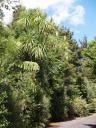

-
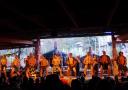
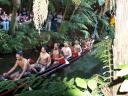
- Welcome ceremony at Rotorura
I’m getting frustrated with New Zealand internet access. There are tremendous number of providers selling access time and claiming to offer access from everywhere in the country. Others are strictly local which means a traveler loses unused time when moving from one location to another.
The wireless network in Helensville is so bad it only allows you to log on to use your time once. When you sign out, whatever time you had left is gone. What is worse, the same thing applies when the community network loses contact with you, which it does.
The coin op system at the ferry terminal in Wellington simply took my money and did nothing.
Some hotels charge ridiculous internet rates and service is sometimes pathetic compared to what we are used to.
Some services are wonderful which makes the whole experience very frustrating. To paraphrase Forest Gump, internet service in New Zealand is like a box of chocolates. You never know what you are going to get.
As this is written, I have been frustrated for several days in my attempts to get good enough access to upload items to the website. With limited available time slots available on the road, reliable service would be appreciated.
I’m sure local folk know whom they can count on and whom they cannot.
Mount Maunganui, Rotorua, Lake Taupo
Mount Maunganui is an oceanside suburb of Touring. We were there on Sunday, February 17. The community and the beaches were crowded and noisy.
We were surprised to see little children playing in the surf while parents watched casually from shore. We asked a couple of lifeguards about rip tides and were told they were present and dangerous.
A popular attraction in the community is the hot pools facility. Our motel, like most others provided complimentary passes. The pools are heated geothermally and patrons pick the ones offering the degree of heat they prefer. One includes metal tubes that pour a heavy stream of hot water into the pool like a shower with no diffusing head. People sit under them and move so the stream hits whatever part of their body is stiff or sore.
Sometimes you don’t realize a spot needs high-pressure, hot-water massage until you get it. It is wonderful!
We moved on the next day through more twisting mountain roads to Rotorua. The park in front of the museum there was like a sudden jolt back in time.
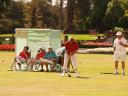
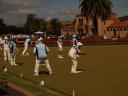
On lawns on each side of the boulevard leading to the museum were teams of well-dressed teams lawn bowling on one side and playing official croquet on the other.
I almost expected to see the Red Queen and courtiers playing with flamingos.
It was like a scene from a British costume drama.
The museum commemorates the history of the community as a popular place for medicinal hot baths. There was one major volcanic eruption that killed 120 people. Here and there, about town, steam clouds rise from yards.
The area has a smell until recently familiar to Miramichiers. There are regular whiffs of hydrogen sulphide.
Live Kiwis
Rotorua is the site of another Maori cultural presentation and hangi. A hangi is a feast cooked by burying meat and vegetables under a fire for several hours or a day. It’s fine but one of those things you do so you can say you did. I think you can achieve the same thing in a slow cooker.
The Rotorua presentation offers an optional tour after dark to a fenced in area where Kiwis live under protection. Kiwis are nocturnal and do not fly. They are dun-coloured, hairy, about the size of small chickens, with long legs and long beaks. Other breeds of the same bird are bigger.
They run with long, high steps and bobbing heads that make them look stealthy. They look cuddly and anxious and bring out the protective instincts like babies and puppies do.
Rats that arrived with the Maori and stoats, and weasels brought in by the Europeans, threaten to make the almost defenseless Kiwis extinct.
Various protection groups across the country harvest Kiwi eggs and incubate them safety from predators and protect the chicks until they are grown. There are also many fenced areas to exclude predators.
Literature about them says that most New Zealanders have never seen one.
The Rotorua tour included an aquarium. Among other species were 35 lb. Rainbow Trout. Rainbows and Browns were introduced from California years ago and have thrived without harming local species. They grow well in local waters which helps explain the popularity of fishing in the lakes at Rotorua and Lake Taupo.
We made a rather abrupt departure from Rotorura after one night when we found two June Bug sized cockroaches in our room. Michelle is not squeamish. She vanquished a mess of roaches and saucer sized spiders in a villa in Mexico some years ago. Still, the presence of roaches in a room that was not hers to fumigate did not appeal.
We mentioned it to the owner and she said they had recently had the rooms fumigated but that the hot earth drives roaches upward into houses.
Lake Taupo
The accommodation we found in Lake Taupo was delightful. The bed was on a mezzanine level with a bathroom featuring a two-person spa tub. There was a very warm pool in the patio.
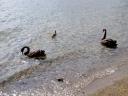
The lake was at the foot of the property. Everyone seemed to go sailing after work. Black Swans combed the shores.
The lake is a volcano crater in the top of the mountain formed by the eruption. It is hot in the summer and frosty in the winter.
As you approach the city, you are struck by huge flumes of hot water vapour misting up from a pipe line that carries steam from a huge geothermal power plant.
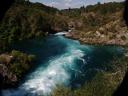
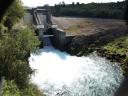
One of the popular attractions in the area one of a series of power dams on the river running to the lake. Instead of building one huge dam, like Mactaquac, there are a group of little ones. The one at the top fills up and then dumps for a half hour.
The water gushes through the turbines and on down to the next dam where it is, again, dumped for a half hour.
Each dam of the series produces electricity in turn.
The company that operates the dams, also operates the steam plant and a biomass plant. It says it produces 22% of New Zealand’s power at peak demand.
A lovely feature of the community is a large botanical gardens on an upper rim of the city. It is late in the season for blooms but still a wonderful, cool and refreshing place to visit. For Maritimers, the variety of exotic trees in the gardens is fascinating.
It is an interesting and comfortable community and very popular with tourists. Michelle and I being addicted to salt water and tides, find it not quite as attractive as so many other New Zealand communities.
The next article will be about a Miramichi reunion in Napier, on the Pacific coast.
The Coromandel and Whitianga
Posted on February 26, 2008
Filed Under Commentary, Travel | Leave a Comment

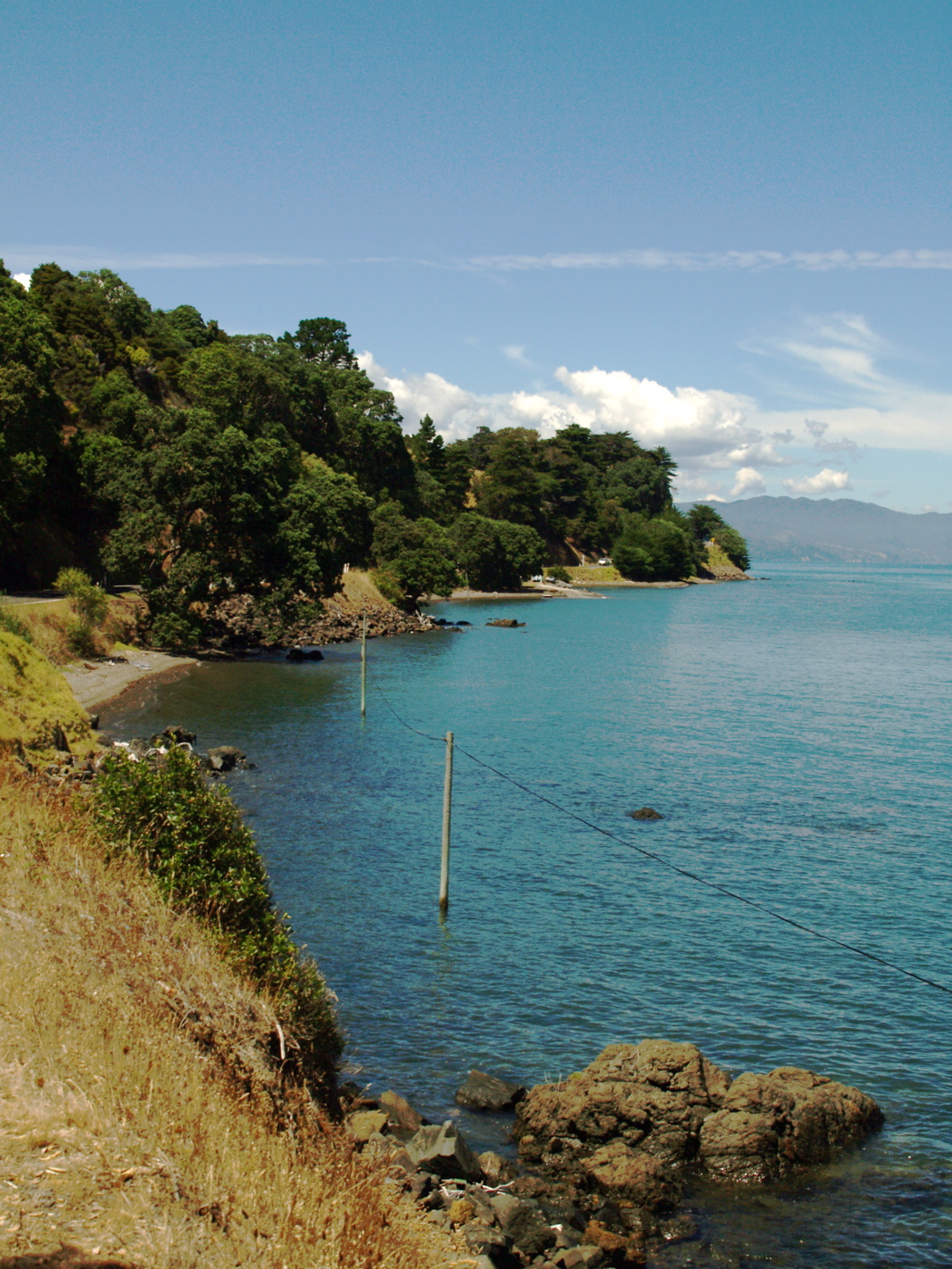


Pics from left to right, top to bottom: (click on pic to enlarge)
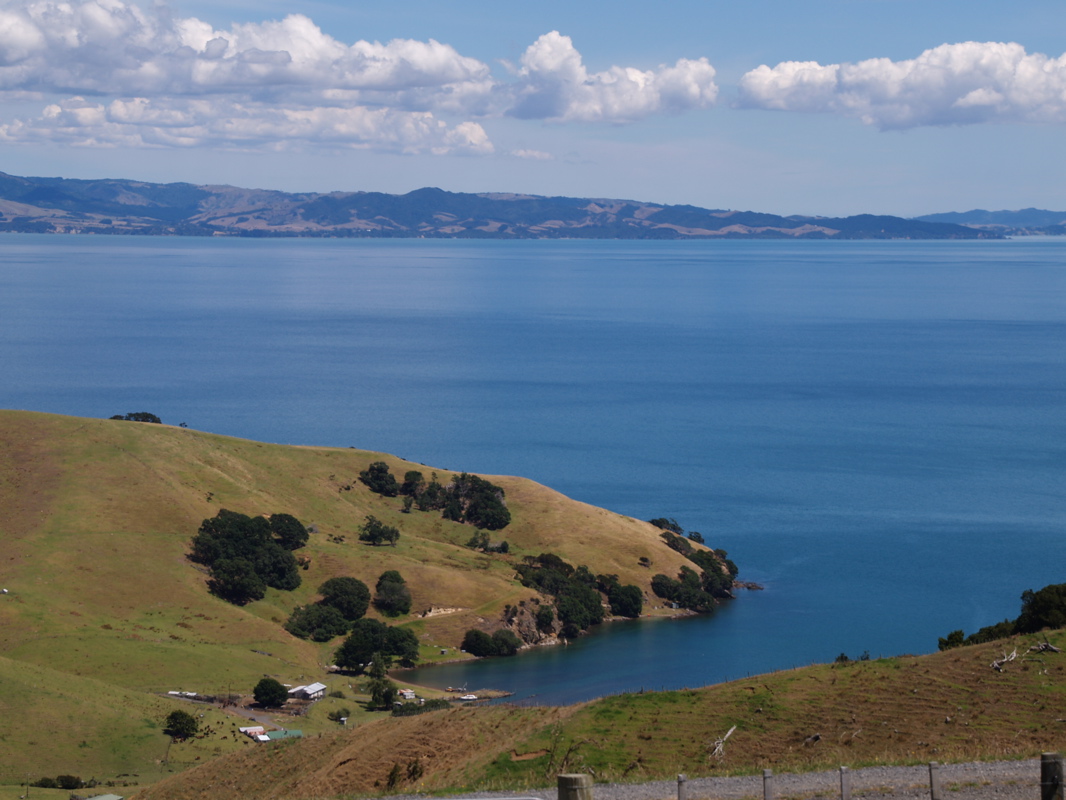
1) View from the road to Coromandel 2) No room for utility poles on road to Coromandel 3) Farm and fishery property on Coromandel peninsual 4) Participant in UK Bristol owners New Zealand tour 5) Giant Flightless Pipi Picker 6) Oyster Catcher? 7) Last of the Pipis 8) Hahei Beach with mermaid on right 9) Cathedral Cove 10) Inside cave 11) Cave near Whitianga
We aren’t used to thinking of the Pacific Ocean as being on the east side of the country. In New Zealand it is.
To the east of Auckland is the Firth of Thames. From Helensville, we return to Auckland, pick up a rental car, and continue south down and around and back up the other side to the Coromandel Peninsula.
The drive up the firth side was the most tense and exhilarating of the trip. In addition to driving on the left for the very first time with a steering wheel on the right, the Coromandel roads are a series of hair pins, switch backs, safety pins and slinkies all rolled into one. The roads are also very narrow.
I got through it all right with the help of my conscientious navigator, Michelle, who reminded me every half kilometer or so that I was far too close to her side of the road. She did, and still does, courteously remind me, with prompt screams, when I drift to the wrong side of the road during or after a 90 degree turn.
It was an intense introduction to mirror driving. Still the views along the way were breathtaking and exhilarating. There were enough places to pull off that I could actually see what was along the road besides cliffs on both sides.
Locals found ways to get at tiny coves to fish and picnic. From some mountainous high points, we looked down on remote, massive farm areas running down to large farm houses and fishing wharves, all seeming part of the same property.
The land, forests and waters of New Zealand are very generous.
Coromandel itself is a delightful little community with a fish shop that sells four different flavours of smoked mussels. They offered regular, garlic, barbecued and Cajun. They smoke every kind of fish available.
McCains
We had fish and chips in a little shop where the sales slip bore the McCains logo. Fish and chips in New Zealand seem truly excellent everywhere. Having fresh available everywhere every day probably helps. Having a jillion tourists in every community may help too.
From Coromandel we worked our way down the other side of the peninsula to Whitianga. That is pronounced Fittyanga, by the way. For some reason, the missionaries gave the Maori language only 13 letters.
On the way we were again struck by the emptiness of the beaches.
Like Paihia, Whitianga is a Miramichier’s dream. It is on a spectacular bay. By February, with the children back in school, many of the local beach front mansions and resort facilities are empty. It was like PEI in July with half the tourists.
Because of the wealth of high priced real estate and the huge tourist traffic, the community of 5,000 population has as many first rate restaurants as New Brunswick. Imagine what our local restaurants could do with that kind of wealthy traffic.
Innovative cuisine
I have to say that I have found a consistently higher standard of restaurant innovation and quality in New Zealand than anywhere else I have ever been. Part of it is that haute cuisine, like everything else, is newer here. Part of it is the sheer plentitude of seafood, meat and produce. Part of it is that New Zealand is more multicultural than, for example, France or Italy. Part of it is that people seem generally better off here. The gap between rich and poor has not widened as much. There seems to be a very large middle class. A large part of it, of course is the huge volume of business provided by tourism which is a much larger part of the total economy than in many countries, especially ours.
Another reason I fell in love with Whitianga is that Vicky Lancaster, a manager at Oceans Resort where we stayed taught me how to gather Pipis clams. She directed me to the proper sand bar and told me to do the twist so my feet would sink down into the sand and feel the clams. It worked. Anyone is allowed 50 Pipis per day and they are easy to gather.
Locals like them steamed and dunked in vinegar. I found them delicious simply steamed. They are tidy, like mussels so it would be easy to use them in linguini with clam sauce.
Oceans Resort, by the way, keeps its own pool at 76 degrees, includes a complete kitchen in the room and provides broad band internet service included in the room rate. Because we wound up staying four nights, our rate dropped to $140 including GST. That’s about $110 Canadian.
We took a water tour to a place called Cathedral Cove and Hotwater Beach among other points. Cathedral Cove is a rock formation with an opening to yet another gorgeous, uncrowded beach. Hotwater Beach is a place where you scoop a hole in the sand as the tide goes and the hole becomes a hot tub heated from below.
I took Michelle to The Fireplace for dinner on Valentines Day. The meal was so imaginative, I cannot begin to tell you what was in it. It was wonderful.
Coffee
A tapas place, Tua Tuas on the main street served amazing meals and coffee at very good prices. Their seafood chowder was as good as the best I’ve ever had. Their lamb loin salad lunch menu item was so good I’m going to attempt it at home.
New Zealanders, to our surprise, given their strong links to the U.K., are very, very dedicated to excellent coffee. That is probably because they are closer to some of the finest coffee producing nations in the world.
They also serve an actual cup of coffee, not a medicinal dose, as we found in Europe.
They do all the normal espressos, capucinos, and lattes but they have their own favourites. One is called the long black and is just a cup of very strong, very good, black coffee. The other is called the flat white and is the same coffee with frothed milk.
They don’t go in for all the candy and dessert items Starbucks puts in coffee in North America. That’s just fine with me.
Traveling to and from Whitianga, I came up with a guess as to why Kiwis don’t drive tiny cars and do drive a lot of mid-size SUVs. The trailer hitches are the clue.
Most vehicles seem to be pulling a boat. Others, although not as many, are pulling camper trailers.
The country is also full of camper vans and motor homes. At of the motor homes are Mercedes or Nissan and other makes. They look like intercity buses except that they are, in size, somewhere between a North American van and a North American motor home. People park them on the streets. It seems the perfect size to me.
In Whitianga, on the weekend, a young man with a tractor kept himself busy all day putting boats into the water and taking them out. At dusk, we saw him going up the main street pulling a largish cabin cruiser that was obviously going to the boat yard.
The sight of marinas and sail boats everywhere made me think it would make more sense for Johnny and Juanita McKendrick to live in Whitianga. The diving and snorkeling and kayaking made me think John and Joyce LeBlanc belong there too.
I thought of my Woodstock buddy, Lloyd
Bragdon, who plays sax with The Downtown Blues Band when I saw a Valentine card that said something to the effect that “I love it when sheep play the sax because I know they REALLY have chops!”
An odd thing happened in Whitianga. I was at the hotel reception desk when an English fellow came in looking for a bucket to wash his car. Oddly enough, they didn’t have one so I offered him the $1 bucket I’d bought for clam gathering. I was puzzled to see him using it to wash what looked like an old Studebaker. I couldn’t figure out what a tourist would be doing in that. I speculated that perhaps he was visiting relatives in New Zealand and they had lent him one of theirs for a trip.
Later, the bucket reappeared, upside down, at our door with a campaign button on it saying UK Bristol Owners NZ Tour.
Apparently a sizable number of British people who own Bristol autos shipped them to New Zealand for a tour. I’ve had cars I really liked but that seems a tad eccentric to me. I have to admit I like people who are that kind of eccentric.
The next report will be about volcano territory. Michelle says I am going to condense these reports to get caught up. It is hard. There is so much different and interesting here.
DAC
Miramichiers settled Helensville
Posted on February 19, 2008
Filed Under Commentary, Travel | Leave a Comment
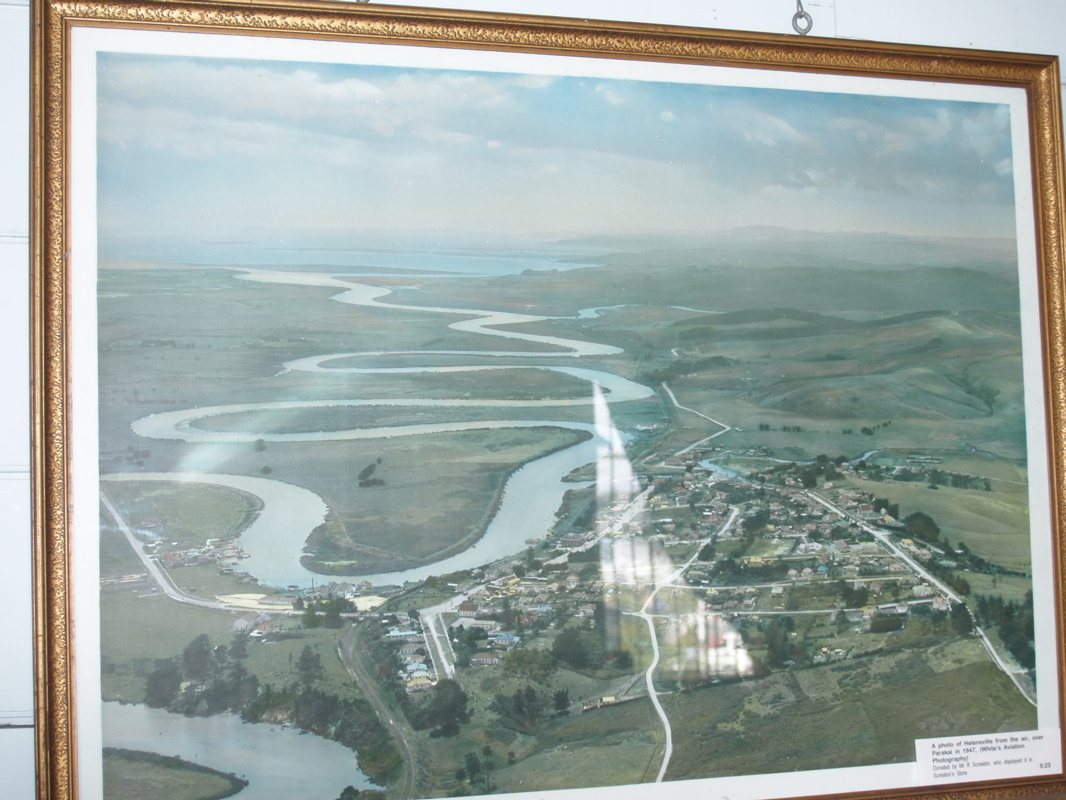


Click on pictures to enlarge. From left from top – Helensville from the air; The Seagull; John & Helen McLeod; Isaac & Janet McLeod; Helensville Pioneer Museum staff, Glenyss Blackshaw, Judy Lloyd, Jean Davidson
Years ago, I was excited when a Miramichi man told my father, George, about coming across a New Zealand town settled by Miramichiers.
Dad had a great story in the “Leader” about it. Years later, I printed the story again. Planning this trip to New Zealand, I looked up Helensville on the web. I was surprised to learn Helensville tells the world it was settled by people from Nova Scotia.
http://www.helensville.co.nz/general/history.htm
Arriving in the community, I learned that the community even flies a Nova Scotia flag on some occasions.
It is true that John McLeod was born in Pictou, Nova Scotia but his brother Isaac and wife and John’s wife Helen (nee Alexander) were all Miramichiers from Douglastown and Bartibogue, where Isaac had 400 acres. The trip was organized and financed from Miramichi and the 19-ton Seagull, a New Brunswick built vessel, was purchased in Saint John, New Brunswick.
Other that John having been born there and the ship stopping in there on its way south to New Zealand, the trip had virtually nothing to do with Nova Scotia.
My source for all this information is two books about the history of Helensville in the museum there.
Ghostly experience
The ladies who volunteer in the Helensville Pioneer Museum are delightful. They are cheery members of that army of world volunteers who work for generations with no financial reward, little thanks and pathetic resources, to protect and preserve information the value of which escalates with every passing year.
One of these ladies, Jean Davidson, was pulling down a book of Helensville genealogies for me when a sheaf of files spilled out of the shelf to the floor.
Michelle scooped them up and put them on the table. She gave a little yelp when she saw that the top file was a copy of an article on the founding of Helensville written by George Cadogan and published in the “Atlantic Advocate.”
Just a coincidence, I suppose – one more example of my astonishing good luck – and yet . . . .
Once again, I salute my father George who guides me still and, like my mother, is more alive to me than many people now physically present.
Remarkable story
John McLeod was one of those men always looking for the next big thing. He followed the gold rushes of the day all the way to Australia before finding success as sawmill manager in Henderson.
After almost a decade away from his home and wife in Douglastown, he returned to convince his brother and wife’s family that prosperity awaited in the Kauri forests of New Zealand.
Eventually 30 souls set off to the bottom of the world in a 19-ton, two-masted vessel. The Seagull sailed from Douglastown on October 1, 1861.
They ran into terrible storms, one of which dismasted the ship and caused the captain to lock himself in his cabin and refuse to come on deck.
One boy died and Helen’s daughter, Basselina, was born on the way.
The locations of Helensville and Douglastown bear some small similarities. Helensville sits on the side of a river, a few miles up from a bay which empties into the sea. The river is, however, tiny compared to the Miramichi.
The climate is, of course, far more clement.
Not having ready access to the archives of the local Miramichi papers at present, I can’t give credit to the man who originally tipped Dad to this fascinating story. Perhaps I will be able to do that when I get home.
In the meantime, I’m thinking about how to present a New Brunswick flag to the town and historical society of Helensville in a way that will make them identify with us and not just give offence.
Irish refugee
The star accommodation in Helensville was fully booked. The owner tipped up to, and booked for us, what he called the best stay value in New Zealand.
He sent us to Ormond House, a brand new, stunning mansion about 20 minutes out of town. Our hosts were Martin and Bridie Butler, formerly of County Meath, Ireland where they ran a gardening centre. Like many people with businesses that peak in summer, they began to travel to warmer climes for vacations in winter. Martin has a medical condition that makes cold impossible for his health.
We found their life story interesting especially told in Martin’s lyrical Irish voice that makes every paragraph sound like a song.
Like the occasional Irishman before him, Martin had left looking for work and became a carpenter in Australia. He went home when Australia had an economic slump. A bicycle shop he started gradually morphed into a successful garden centre which was his passion.
Besides luxurious accommodations
( www.ormondhousenz.com )
they served us a sumptuous and delicious breakfast that included scrambled eggs and avocado in a flaky, buttery crossaint.
Paihia & Bay of Islands
Posted on February 17, 2008
Filed Under Commentary, Travel | 1 Comment


Pics from left: Yacht through trees from Russell, the former notorious whaling station; Lone campers on an island beach in Bay of Islands; Maori performers at the Waitanga Treaty grounds in Paihia.
Paihia on the Bay of Islands, four hours north of Auckland is an excellent place to settle in for a few days on any trip to New Zealand. It is a Miramichier’s dream of a place. As the name indicates, the bay is full of islands. Each one has its secluded, little-used islands. On a boat tour we saw cove after cove and beach after beach occupied by one boat and one camp site.
The bay is full of dolphins who seem to delight in rushing to frolic about any passing vessel.
Following the European discovery of New Zealand by Abel Tasman and then Capt. Cook, settlers began to move in.
When whalers from Europe and the US set up in Russell on an island just offshore from Paihia, local society really started to go to the devil.
A group of Maori chiefs asked bishops of the Anglican church to ask for protection from England. Queen Victoria sent one administrator to represent British power to protect settlers and the Maori.
That was the precursor to the treaty that established the relationship between Europeans and the Maori to this day.
On a stunningly beautiful piece of their land, the Maori present a program of their history and culture including rituals, music, dance and re-enactments.
Maori, Miramichi connection
New Brunswickers may be interested to learn that the bud, called the koru, of the silver fern and the leaf of the fern are the two main symbols of New Zealand. The Maori ate the koru although it is not a regular, annual, food item for New Zealanders as the fiddlehead is to us.
New Zealand was created by volcanoes. Because of that, there was almost no transfer of flora and fauna from other continents until the arrival of man. There is one bird that flies back and forth between New Zealand and Alaska, covering the 7,000 miles in one, non-stop flight.
The original south sea island human settlers arrived less than 1,000 years ago and became the Maori. Those humans trace their lineage back to the Europeans who arrived in North America and worked their way south.
One cannot help but be struck by a number of similarities between the art, culture and historic practices of the Canadian First Nations and the Maori.
Perhaps the most striking of these is the common appearance of the fern bud. The Miramichi-Maori connection is coincidental, of course. The New Zealand fern grows to a good-sized tree. Still, it makes an impression.
Maritime music & budget travel
In Pahia, we discovered a couple of things of more than local interest.
One is that New Zealand has a very sophisticated and high quality network of what we would call hostels.
These hostels, unlike our usual image, may include private rooms and baths. They are rated by the national accommodation rating service, Qualcom. Several of them rate four of five stars.
They also include dormitory style beds and all have shared kitchens and lounges with TV and usually internet access. A national backpackers association also provides ratings and a directory of the hostels.
The hostels are usually right in the middle of community attractions, sometimes right on the beach making everything convenient for people without vehicles.
One we visited was also the highest ranked bed and breakfast in the community. The only difference between hostel accommodation and bed and breakfast seemed to be the number of beds in the room the visitors choose and whether they make their own breakfast or not.
It is a thrill to learn that young people can tour New Zealand very economically if they can get here.
Next door to the fine backpackers hostel in Paihia, we were having a beer and a sandwich in a bar with a local singer with a guitar. One of the first songs All Quinn sang was “Sonny’s Dream,” and he turned out to be a Stan Rogers fan.
That, and the discovery of the backpackers facilities made that a big day for us.
The next report will deal with Helensville where the people came from Miramichi but think they came from Nova Scotia.
DAC
Top tip of New Zealand
Posted on February 16, 2008
Filed Under Commentary, Travel | 1 Comment


Pics from beginning: 1) Cape Reinga Lighthouse. Pacific Ocean on the right. Tasman Sea on the left. The very top of New Zealand. 2) The 64-mile-long 90 Mile Beach. Tour buses race up or down the beach depending on the tide at the time of the tour. 3) An ancient, protected Kauri tree. (Pic of Michelle in carved Kauri chair removed on command)
Click on pics to enlarge.
Please excuse the lousy formatting. For some mysterious and extremely frustrating reason, my posting program has decided to present me with a brand new set of parameters. I’ve never seen them before and have no idea what they think they might do. Even when I experiment, they don’t do anything useful. Help, Colin Casey, help!
I’m developing a new respect and sympathy for Rick Steeves, who does the popular video tours of Europe. I’m already over a week behind with my reports on our travels.
From Auckland, we took a bus to Paihia, on the Bay of Islands, four hours north of Auckland. As the name would leave you to believe, the bay is a boater’s paradise. There are hundreds of island beaches to explore. It is common to see one boat and one tent on a beach.
We took a bus tour north to Cape Reinga, the top of the country. On the way we stopped in at a Kauri forest. The story of the Kauri is much like the story of our own and the British Columbia forests.
These ancient trees, some predating Jesus Christ, were stripped from the country to the point that it is now illegal to cut even one.
In addition to felling the best of them, settlers bled others for a valuable gum used in the manufacture of shellac and hard enough to carve for jewelery.
When the trees and the gum were no longer available, diggers probed the forest soil for ancient balls of the gum.
The Kauri timber is astonishingly durable. To this day, people dig up trees sometimes thousands of years old. These ancient trees are very valuable for the making of very expensive furniture by artists and artisans. A nicely inlaid dining set sells for well over $20,000. It has a beautiful, lustrous sheen.
Being in one of the remaining protected Kauri woods, like being in Cathedral Grove, between Nanaimo and Port Alberni on Vancouver Island, is a deeply spiritual experience.
I suppose part of the reason is that the towering, ancient trees and the dark forest floor soak up all sound returning no reverberation. It is also humbling to be in the presence of something alive, so old and so big.
The Maori held the trees in such respect, they even gave many of them individual names.
Sheep and avocados
The countryside along the road to Paihia is rolling hills somewhat like that of western New Brunswick but with much higher hills and, to us, more exotic trees and birds.
The hills are tightly terraced by generations of sheep grazing around an around them.
Creating land
New Zealand is a bunch of dormant volcanoes strung together with sand bars. Early settlers in the northern end, planted a beach grass to hold the sandy peninsula from moving around. When that worked, they planted lupins to put nitrogen into the soil which provided nutrients for trees and crops.
Now avocados are a popular crop. On one huge farm, a new owner is lopping the tops off hills to fill in ravines to level off the land for farming avocados.
New Zealand does not have the rivers New Brunswick has. Most of its water is collected from rain. Our bus driver wondered if there will be enough water to nourish all those avocado trees.
Cape Reinga
The tip top of New Zealand features a lighthouse. On one side is the Pacific Ocean, on the other the Tasman Sea.
It is spectacular but the main thing about being there is to be able to say you were. It is like getting to Uclulet or Tofino on Vancouver Island or Cape Spear in Newfoundland.
The amazing thing about Cape Reinga is “90 Mile Beach” running down the east side of the peninsula. It is actually only 64 miles long but that is quite impressive enough.
Our tour bus drove down the length of the beach on the beach. It has to make the trip at low tide. The only sand hard enough to drive on is that uncovered at low tide.
The buses are specially designed and built to handle the roads and turns on the way to the cape and the sand and salt water on the way down.
Drivers unfamiliar with such things as tides and rogue waves lose their vehicles on the be ach each year. Vehicle insurance does not cover anything that happens on the beach so errors are very expensive.
Harsh treatment
As we reboarded our bus from one beach stop, we got a first-hand lesson in how New Zealanders feel about their environment. One elderly foreign passenger tossed some litter on the shore.
Our driver picked it up and accosted the miscreant in extremely hostile manner. At one point, I thought he had slapped him but he had slapped his own arm while right in the offender’s face and telling him in no uncertain terms that one does NOT do that in his (the driver’s) country.
It must have been mortifying for the passenger but it was impressive. Would that we were as willing to embarrass our own litterbugs in our own country.
DAC