Harvest Jazz & Blues Festival among the best run anywhere
Posted on September 21, 2007
Filed Under Commentary | Leave a Comment
My children buy me an ultimate pass to the Fredericton Harvest Jazz & Blues Festival, which takes place the second week of September each year.
It started off well 17 years ago and has steadily evolved into an event so well run it has to compare favourably with any festival anywhere.
The first thing you’ll want to know, of course, is that the quality of the music is simply terrific.
This year Arturo Sandoval, Government Mule, Molly Johnson and Dr. John were among the headliners.
A tribute to the late Prime Minister of the Blues, Dutch Mason, included his Juno winner, son Garrett and a fountain-of-youth set with Matt Minglewood and Sam Moon. Minglewood and Moon’s doing Marshall Tucker’s “Can’t You See?” complete with Matt’s poignant goin’-down-the-road story is prominent on the sound track in rock and roll heaven.
There is great variety including gospel and Cajun Zydeco. New Orleans Jazz & Heritage Festival has been an obvious inspiration to the festival for both ideas and talent.
International, national and regional headliners draw the crowds and provide an audience and recognition for local talent.
I don’t know why or how it happened, but the music industry is not a big presence on the HJ&B scene. That is quite probably one of the big reasons for its success and popularity. The program includes what the directors believe the audiences want to see and hear, not what some label is promoting this year.
The festival works with, not against, existing bars and clubs. People who can’t get or can’t afford tickets to the major venues can find great live entertainment all over the city. It is a wonderful cultural introduction to the city for the thousands of students there from all parts of the world.
There are more free venues than there are paid. A fan without a ticket can even stand by the exits at the major venues and hear the headliners free. Small stages are set up on almost every block. Every day there are free shows, featuring headliners, in Officer’s Square. The last concert of the festival is held there on Sunday afternoon. This year Molly Johnson headlined.
The free daytime venues also provide an alcohol-free environment for those who want that. Drinks are available in a separate area.
Drink prices are not exorbitant as they so often are when the audience is captive. Drink and beer tickets sell in packages of five for $20.00, not much different than most small-town bars. Most patrons aren’t much motivated to sneak their own in or load up before they arrive. Mind you, serious music fans aren’t there to be seriously drunk anyway.
Fredericton City Police deserve kudos for being present but not in anyone’s face. They’re friendly and helpful. They help create the tone.
Festival organizers have always aimed for a clean festival but it is really serious now. Volunteers comb the venues gathering up discarded containers and recycling bins are everywhere.
There is a flexible package of event, day and weekend tickets available. The ultimate is the ultimate because it allows the wearer to move from venue to venue to get a taste of various programs. It was what allowed me to see all of the Government Mule show in the Bud Light Blues tent and still make the Minglewood, Moon, set in the Aliant Mojo tent.
Being so impressed with the brilliant management Harvest Jazz & Blues Festival has exhibited over the years, I am trying to get them to create one more type of pass. Preliminary surveys of fest fans indicate it would be very popular.
I want an Ultimate Pass Squared Pass. The Ultimate Pass lets you into any venue. Squared it would let you into every venue – at the same time.
On Saturday night, for example, I wanted to be in the Mojo Tent for Dr. John and L’il Brian and the Zydeco Travelers and in the PQA venue at the Boyce Market for Grand Derangement, the Acadian group from Nova Scotia. I needed a pass to be in both places at the same time.
For those of you who saw Government Mule and, like me, always wish the CD’s could be as good as the performances, here’s an exciting discovery. They sell session recordings on their website! You can go to: http://www.mule.net/from_the_road/details.php?year=07&month=09#13WH
and buy and download the Fredericton or any other show including Warren Haynes solo acoustic show. Incidentally, HJ&B promoted the fact that Warren Haynes of Government Mule is #23 on the “Rolling Stone” list of the top 100 guitar players of all time. To see the list click here: http://www.rollingstone.com/news/story/5937559/the_100_greatest_guitarists_of_all_time/
The final thing that must be said is that the hundreds of volunteers who work the bars and doors and grounds are simply wonderful. They’re cheerful and plentiful and the festival simply isn’t possible without them. Festival organizers keep reminding the audiences to thank them. They richly deserve it!
The organizers too, of course, are volunteers.
http://www.harvestjazzandblues.com/
Thank you!
David Cadogan
Fictional Sergeant Klell Hazard
Posted on September 19, 2007
Filed Under Toasts | Leave a Comment
In the Movie “Gardens of Stone,” James Caan plays Clell Hazard, a Vietnam war era, burial detail sergeant at Arlington Cemetery. His standard toast when drinking with friends is, “Here’s to us! And those like us! Damn few of us left!”
Frank Sinatra
Posted on September 19, 2007
Filed Under Toasts | 1 Comment
Here’s to the confusion of our enemies! – Frank Sinatra
Metepenagiag Heritage Park project an amazing triumph for community
Posted on September 19, 2007
Filed Under Commentary | Leave a Comment
Metepenagiag Heritage Park is an amazing triumph for the Mi’kmaq community also known as Red Bank. It is owned and operated by an independent community corporation, Metepenagiag Heritage Park Inc. Every element of the message it presents is the consensus of the community and its elders. It goes far beyond being the significant tourist attraction it will be. It is, more importantly, a powerful education tool for everyone and a source of pride and inspiration to all First Nations members.
From the time Joe Mike Augustine brought the Augustine Burial Mound to public attention in 1972, to the August, 2007, official opening of the ultra-modern facility, trails and grounds, determined community leaders overcame dozens of obstacles that often looked insurmountable.
At the same time, community and outside people joined Joe’s daughter, Madeline, in an almost fanatic dedication to her vision.
Metepenagiag chiefs, going back to the late Don Ward, followed a careful and deliberate path of negotiation with non-natives and consultation with the community and, especially, its elders.
Time and again they refused offers of help that would have taken possession and control away from the community.
They refused help for exploration that would have meant turning over any discovered artifacts to the national museum. They refused an offer from Parks Canada to build an exhibition facility that Parks Canada would have owned, built and operated according to their departmental policies.
Along the way, an almost miraculous series of events and people appeared at opportune moments to nudge the dream along.
If Joe Augustine had not realized what the Augustine Mound is just when he did, it would all be part of bridge abutments or house foundations now.
If St. Thomas University had not reached out to the First Nations community when it did, Madeline’s brother in law would not have been a student there and would not have been able to direct them to Professor Paul Morrissy, an anthropologist.
If the Province of New Brunswick had not just hired its very first archaeologist, Dr. Chris Turnbull, there would have been no one to realize the significance of the finding.
If Dr. Turnbull had not been so determined and so patient, Chief Don Ward and his council would never have decided to trust him and then Patricia Allen and to negotiate the respectful treatment of sacred and historic ground with them.
If Joe’s grandson, Noah Augustine, had not been able to pull together the making of the Conrad Beaubien film, “The Village of 30 Centuries,” the community and potential partners might never have truly realized the potential for Madeline’s vision.
If Pam Ward had not worked on an Oxbow dig as a student, been a very young band councilor when the first feasibility study was commissioned, or become the executive director of the project, it is hard to imagine it could have come to pass.
Winston Churchill once said that his life, going back to being a journalist in the Boer War, didn’t seem to have any particular aim until it turned out to have been the perfect preparation to the wartime Prime Minister of Great Britain in WW II.
Patricia Dunnett’s life seems similarly pre-destined. She took a canoeing course in high school. She monitored and worked her way into a canoe making course organized by Pam Ward. She took a porcupine quill basket making course and then a Black Ash basket making course in the community. When Noah Augustine organized a New Brunswick Day Adventure package to Metepenagiag, she became the guide. She demonstrated her crafting knowledge. She conducted canoe rides in the canoes she had helped build in that course. She made regular calls to Madeline to learn the answers to visitors’ questions.
It was all the perfect preparation to be the first heritage interpreter at Metepenagiag Heritage Park.
Visitors who come out of the video presentation at the Park weeping and in awe of the stunningly beautiful community performers would agree that it is impossible to imagine a better manager of the creation of interpretive services than Wayne Kerr, a consultant with years of Parks Canada service.
People who observed Kerr in action know that he embraced the community driven idea for the park with a fierce dedication. Every move had to be endorsed by the MHP board and the elders. In tune with the community, he developed a presentation that emphasizes that, while the community history and culture are continuous for at least 3,000 years, the community is still alive and here, enduring and progressive.
Mike Hartop, who managed construction, guided the board into becoming its own general contractor. The building is not only beautiful and functional but is the most energy efficient in the province, has minimal operating costs and includes park and trail facilities not in the original budget.
Even the Mohawk barricades at Oka, in Quebec, contributed to the path to success. When First Nations there blockaded attempts to build a golf course on their ancient burial grounds, the Canadian government and its agencies realized it had to begin to listen to and negotiate with First Nations communities. That was a factor in changing Parks Canada policy about owning anything it supported.
It has been 35 years since Joe Mike Augustine made his fateful visit to the Augustine Mound. Times, people and attitudes have changed dramatically. Supporters and champions in government and its institutions have been recruited to the vision and dedication of the Mi’kmaq community champions in Metepenagiag.
Along the way, the process has become what is, in the words of Dr. Chris Turnbull, a model for how governments should conduct relations with First Nations.
Metepenagiag Heritage Park represents a significant milestone in the telling of the story of Canada.
David Cadogan
Conflict of interest disclaimer: It is only fair to mention that my wife, Michelle Cadogan, proprietor of MC² Marketing, is the marketing consultant contractor for Metepenagiag Heritage Park Inc. and that she engaged a local scribe, me, to write a series of articles for release to local and other media. Having said that, I also want to say that I am so proud of her work, with and for the community, I could burst. I know Metepenagiag community members will agree when I say that she performed far beyond the requirements of her contract. That can only be explained by her love for and bond to the women and men who brought Metepenagiag Heritage Park to reality. Having also fallen under their spell, I can appreciate the power of their inspiration, decency, kindness and determination. See the Metepenagiag category of this site for articles on the Park and the people involved.
Two nationally significant historic sites at Metepenagiag
Posted on September 17, 2007
Filed Under Metepenagiag | Leave a Comment


 Madeline Augustine, President and Board Chair; Pam Ward, Executive Director, Metepenagiag Heritage Park, Inc.
In 1972, with a gravel pit rapidly encroaching, Joe Mike Augustine uncovered artifacts from what turned out to be a 2,500-year-old Mi’kmak burial mound. The mound is in the First Nations community of Metepenagiag, known in English as Red Bank.
Following contact and lengthy discussion with the NB Provincial Archaeology Department Chief Donald Ward and council reached a working agreement for the exploration and protection of the site.
In 1975 The National Historic Sites and Monuments Board of Canada (NHSMB) declared the Augustine Mound to be a National Historic Site with a strong recommendation that the site be interpreted for all Canadians.
The Augustine Mound is nationally significant because it and exceptional and enduring expression of Mi’kmaq spirituality, exhibiting burial rituals and artifacts directly connected to Adena traditions in eastern North America 2,500 years ago, 600 B.C.
In 1977, work began on another site discovered by Joe Mike Augustine, the village of Oxbow, a deeply stratified site situated at the head of tide. Excavations were carried out until 1984 by which time a record of continuous habitation for at least 3,000 years up to the present day had been established. Excavations cannot go deeper because they would go into the water table and flood.
In 1980, the Oxbow village site was also declared a National Historic Site. It is nationally significant because it is a unique cultural record of a flourishing Mi’kmaq community which has endured for at least 3000 years and shows a direct relationship between the everyday life of the community and its spiritual centre at the Augustine Mound.
On August 23, 2007, Metepenagiag Heritage Park, a community owned and operated Class A, ultra-modern, visitor attraction costing over $7,000,000, opened to the public. It interprets the sites and displays artifacts, crafts, art, and information describing 3000 years of the community’s continuing history and culture.
“We have been greeting European visitors for several centuries now,” says the official welcome to the Park. “You are invited to come share our music, listen to our stories, handed down the generations by our Mi’kmaq elders.
“View astonishing finds from our two National Historic Sites – the Augustine Mound and the village of Oxbow. See replicas and artifacts, art and crafts, and the culture and the livelihood of our people for the past 30 centuries. Walk our trails, watch a video depicting life in ancient times.
“We’re open all year.”
Park hours are:
May 15 to October 15 – 9:00 a.m. to 6:00 p.m.
October 16 to May 14 – 10:00 a.m. to 3:00 p.m.
Entry fees are:
Adult (17 – 64) $8.00 Senior (65 years and older) $6.00
Youth (6 – 16) $6.00 Family/Group $18.00
A family or group is up to seven people with a maximum of two adults arriving in a single vehicle or visiting together.
School groups (per student) $3.00.
You can get our current information package by:
Calling: (506) 836-6118
Emailing: info@metepenagiagpark.com
Mail: PO Box 302, Red Bank, NB E9E 2P2
Visiting: 2156 Micmac Road, Red Bank, NB
Directions and maps are also available on our web site at:
http://www.metepenagiagpark.com/ .
Click below to enlarge


Student excavator now heads Metepenagiag Heritage Park
Posted on September 17, 2007
Filed Under Metepenagiag | Leave a Comment

Metepenagiag Heritage Park – ©Nelson Cloud
In the summer of 1984, powerful emotions washed over a raven-haired young Mi’kmaq woman as she stared at a few bones in her hand. She realized, for the first time, her connection to ancient traditions and culture and ancestors who had lived on the same spot for 3000 years.
She was working as a summer student on the last of a series of exploratory digs in her community near Red Bank, known to the Mi’kmaq as Metepenagiag. An archeologist had just explained to her that the bones she had found were sturgeon, a staple fish of the villagers’ diet in ancient times.
Her ancestors went out onto the water at night with torches and spears. The sturgeon would be attracted to the light and speared. Male sturgeon grow up to six feet in length and 100 lbs. Females can reach 15 feet long and weigh as much as 800 lbs. They have armour plate rather than scales.
( http://www.dnr.sc.gov/cwcs/pdf/Sturgeon.pdf )
The bones she had found came from one such nighttime hunt. Imagine the battles that took place on those torch-lit nights.
“I held those bones in my hand and realized I was part of something ancient to be proud of,” she says.
Band member, Joe Augustine, had triggered the archeological interest. In 1972, he saw pictures in a magazine article that led him to believe the local mounds he had wondered about for years were ancient burial sites.
In 1992, the same young woman who had worked on the dig, now a very young band councilor, was one of the members to sign off on the decision to do a feasibility study for a heritage park project.
On August 22 of this year, that same woman, Pam Ward, now Executive Director of Metepenagiag Heritage Park Incorporated, welcomed the first tourists to a spectacular, hi-tech, $7.2 million dollar centre dedicated to the preservation, protection and presentation of the community’s heritage.
Metepanagiag is the home of not one but two National Historic Sites. One is the Augustine Mounds. The other is Oxbow, the “Village of 30 Centuries.” The current residents and their ancestors have lived in Oxbow continuously for at least 3,000 years.
The park is be open from 9 a.m. to 6 p.m., seven days a week and holidays.
For visitors, a highlight is a 20-minute video presentation surrounding the audience and on the floor. It tells a story of a homecoming from a trading mission to the Ohio and a budding romance.
There are also trail walks, replicas, and the opportunity to observe continuing research.
“We are hoping visits will average two hours,” says Ward.
The Park facilities are also available for meetings and conferences.
In addition to the interest from visitors from far and wide, Ward says she hopes Metepanagiag Heritage Park will help young Mi’kmaq develop a healthy pride in their people and past.
“You need to know where you come from to know where you’re going,” she says.
Joe Mike Augustine, the spirit of Metepenagiag
Posted on September 17, 2007
Filed Under Metepenagiag | Leave a Comment
 Joe Mike Augustine
Everyone who speaks of the late Joe Mike Augustine does so reverently. Most of them mention some of the same things about him that made such a great impression on them.
Augustine was the man who brought to public attention not one but two National Historic Sites, the Augustine Burial Mound in 1972, and the ancient Mi’kmaq community site of Oxbow, labeled the “Village of 30 Centuries,” in 1982. He died in 1995 knowing that his dream that there would be a place where Metepenagiag’s heritage, culture and artifacts could be displayed was safe in the hands of his children and grandchildren.
Everyone mentions how his spirit is still alive in Madeline. She insisted her father take what he had found to Fredericton to try to find out what it all meant to the community. From that day to this she has been a continual influence in the effort to bring Joe Mike’s dream to reality.
By all accounts, Joe Mike was a kind, generous, and gentle man who lived a quite traditional life. He fished, hunted, trapped, made baskets and even baked traditional Mi’kmaq bread.
He was always willing to share his knowledge and had a wicked sense of humour.
Archaeologist Patricia Allen tells of going raspberry picking with him in the local gravel pit. There was a pillar of gravel about 20 feet high with a patch of grass and raspberry bushes on top.
“Okay, Pat, I’ll get these. You get those ones up there,” he said.
On another occasion, Allen having learned about ice fishing from Joe Mike, cut a hole in the ice and was sitting on a bucket, fishing. She got a bite and pulled the fish to the surface only to find it was much too big to fit through the hole she had cut. She was trying to figure out what to do when she saw Joe coming across the ice.
“I called to him for help,” she says “And he came shuffling over and looked down at the fish face in the opening.
“What am I gonna do, Joe?” she asked.
“Well, I think you better get a bigger hole,” he said walking away, his shoulders shaking with silent laughter.
She also tells of him spinning tales to young university students working on the Oxbow excavations. He could convince city kids that he hunted moose by sitting in a tree, jumping on the back of a passing moose and riding it to exhaustion.
His daughter, Madeline, now president and board chair of Metepenagiag Heritage Park Inc., remembers that he was a voracious reader and always eager to learn new things.
Chief Noah Augustine, Joe Mike’s grandson, is very emotional when he talks about how, if his grandfather had not discovered the mound when he did, the whole sacred site would have been hauled away in gravel trucks. He speaks of the huge debt he feels for his grandfather’s contribution to the rebirth of the community’s culture.
He remembers his grandfather’s satisfaction when, on his death bed, he watched the “Village of 30 Centuries” for the last time and was reassured that many people were going to see the film and know the ancient story of Metepenagiag.
Metepenagiag Heritage Park board member and original committee member, Wilfred Ward remembers how generous Joe was with his knowledge, always willing to share with anyone who wanted to learn but never pushing it on anyone.
On Metepenagiag Day, Wednesday, August 15, Metepenagiag Heritage Park held official blessing and opening ceremonies to introduce the interpretive centre to the community for its members to be the first to see it and to take ownership.
Joe Mike Augustine’s daughter, Madeline, now president and board chair of Metepenagiag Heritage Park Inc., says she saw an eagle flying over the site and knows the spirit of her father was there with the community.
“I thought he’d struck gold!” – Madeline Augustine
Posted on September 17, 2007
Filed Under Metepenagiag | Leave a Comment

Madeline Augustine and her father, Joe Mike Augustine
Madeleine Augustine, daughter of Joe (Joe Mike) Augustine) remembers the day he brought home samples from what is now the Augustine Mound National Historic Site.
“He had known about the mound for years,” says Madeleine. “He thought it was something, perhaps a ceremonial location of some kind.”
“He was always reading,” says Madeleine. “One day, in about 1972, he came across an article with a picture that looked like the mound. The article said it was a burial mound.
“He took his knapsack and his shovel and went across the river. He came back, spread newspapers on the table, spilled out his sack of dirt and began to pick apart what he had dug.
“Things began to appear — arrow heads, spear points, birch bark wrapping, leather cords, necklaces, rings.”
When she saw copper beads, Madeleine thought he had struck gold. She laughs warmly saying “In a way, I guess he had!”
Now, 35 years later, the Mi’kmaq of Metepenagiag feel sure the spirit of Joe Mike was present at the opening of the ultra-modern tribute to what they call his re-discovery of their ancient, sacred, ancestral burial site.
After years of archaeological research, a temporary museum Madeleine set up in a portable classroom, planning , lobbying and constant consultation by and with band councils, elders and members, Joe Mike’s dream is ready to welcome the public.
Madeleine Augustine is President and Chair of the Board of Metepenagiag Heritage Park Inc.
The MHP board, chosen by chief and council and a community steering committee, includes a youth member, currently Marie Levi; an elder, Wilfred Ward; a representative of the consultative and interpretive committee, Madeleine Augustine; band councilor, Patrick Ward; City of Miramichi, Rupert Bernard; the community at large, Dr. Chris Turnbull.
Four funding agencies involved in the project are represented: Indian & Northern Affairs Canada, Atlantic Canada Opportunities Agency, Canadian Heritage, and Province of New Brunswick Regional Development Corporation.
There is one Mi’kmaq legal advisor and a representative of the Mi’kmaq and Maliseet Institute at the University of New Brunswick.
Three principles, set by the community, guide the board. They are: Preserve, Protect and Present. The community’s deep respect for the sacred nature of the burial mound dictates that no visitors will ever be allowed there. The mound is represented in a replica display in the MHP building.
Roger Simon paintings commemorate ancient Metepenagiag
Posted on September 17, 2007
Filed Under Metepenagiag | Leave a Comment


Roger Simon painting photos copyright Metepenagiag Heritage Park Inc., Estate of Roger Simon
The late Roger Simon, of Big Cove, was commissioned, in 1994, to do six paintings of ancient Metepenagiag. At the time, there was a grant program “Access to Archaeology,” through Heritage Canada. Councilor Anthony Haddad and archaeologist, Patricia Allen, co-ordinated the project.
Born in Big Cove, New Brunswick, Roger attended George Brown College, Toronto, Ontario, from 1974-1977 and the New Brunswick Craft School from 1981-1983.
His work has been exhibited throughout New Brunswick: Landmark Gallery, St. Thomas University, The Playhouse, Kouchibouguac National Park, Beaverbrook Art Gallery, Gallery Connexion, Monsignor Boyd Centre, Maison des Arts, and Université de Moncton. Roger’s work has also appeared at the Dalhousie University Art Centre, Doomsday Studio and Art Gallery of Nova Scotia, Halifax, Nova Scotia; and the University of Saskatchewan, Regina. His murals are at the Big Cove and St. Mary’s Band Offices, the Micmac/Maliseet Institute and the Miramichi Hospital, and the Dept. of Indian and Northern Affairs, Toronto, Ontario.
Roger’s paintings have appeared in many publications and as a background in a Disney film. Examples of his work are in the Canada Council Art Bank, the Micmac/Maliseet Institute, Canadian Embassy, Moscow, Russia, and the Government of Canada’s National Indian Art Collection.
Patricia Dunnett never dreamed of Heritage Interpreter job
Posted on September 16, 2007
Filed Under Metepenagiag | Leave a Comment
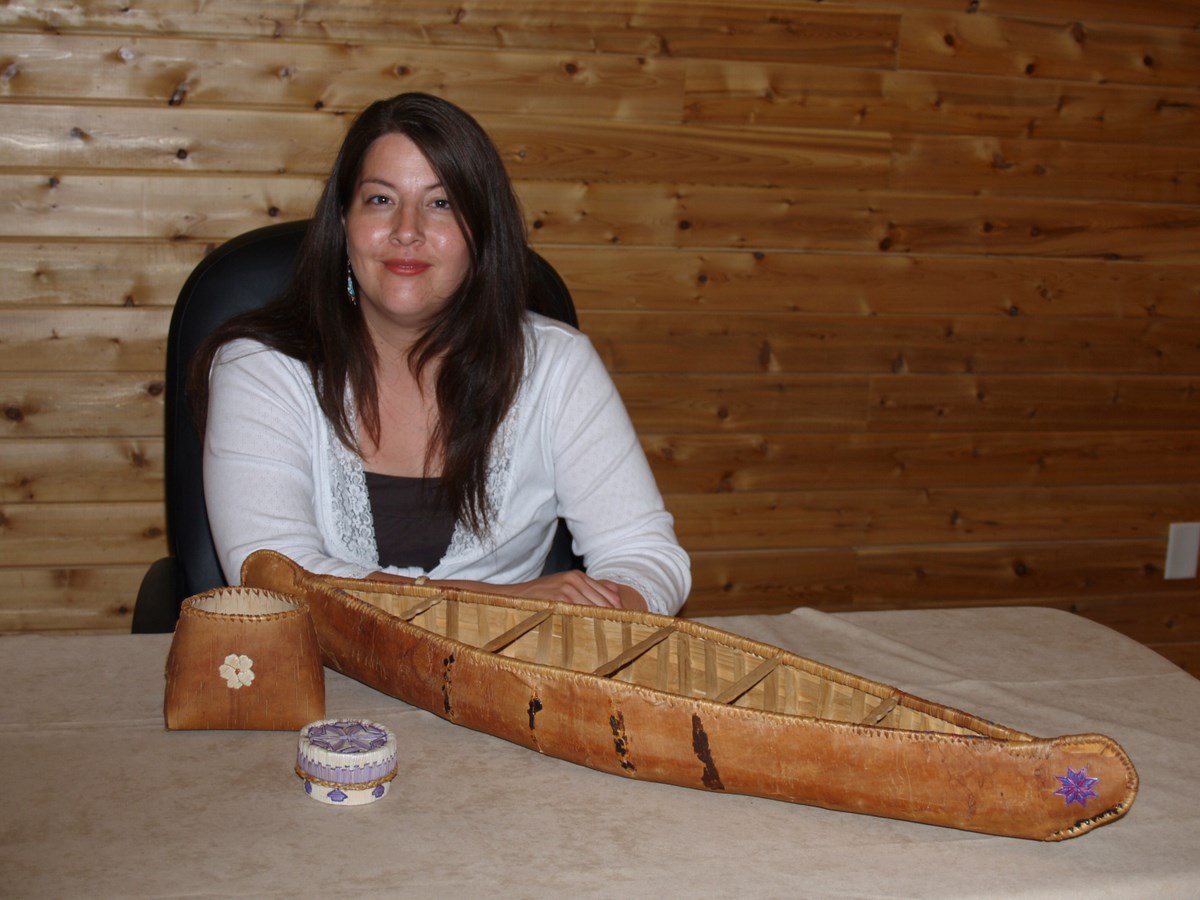
Patricia Dunnett with a Black Ash basket, birch canoe model and the first porcupine quill basket she ever made.
A crucial milestone in the life of Patricia Dunnett, Heritage Interpreter at Metepenagiag Heritage Park, was when her good friend, Diana Witheral, coaxed her into taking a porcupine quill basket course she was teaching.
The community was promoting a renaissance of traditional arts and crafts at the time.
“Until then,” she laughs, “I’d never thought of porcupines as anything but road kill!”
Patricia, the grand daughter of Joe “Joe Mike” Augustine, grew up with archeologists around the community and hearing the stories and seeing examples of the Mi’kmaq arts and crafts.
“I was always into arts and crafts, growing up,” she says. “But I had never really thought of doing native arts and crafts, especially as a career.”
After high school, she went to the New Brunswick Community College campus in Moncton to take business courses. Patricia married started her family and decided to come home, where she took her first craft course.
She still has the very first porcupine quill basket she made. Quillwork is still her favorite craft. She explains that there are three types of quillwork: embroidery, wrapping and plaiting, which is like weaving.
Later René Martin from Listuguj in Restigouche, Quebec, came to Metepenagiag to teach birch bark canoe making.
By the time Patricia heard about it, the course was full.
“I wanted in so bad!” she says. “I went and pleaded with him to just let me watch.”
He did and Patricia went every other day for three months. She learned how to collect and prepare birch bark, cedar, spruce roots and spruce gum.
In the final month, one student left and she got into one of the two teams of five. The two 22-foot canoes the teams built would twice play a part in later stages of her career.
In another craft course she learned how to make Black Ash baskets. She demonstrates how a basket maker pounds the Ash with a hammer making it split into thin laths.
“I got a good, strong right arm doing that!” she says, laughing. Almost everything she says is said with a laugh. She is obviously thrilled with what she does and full of admiration for the people who taught her along the way.
She got her first chance to put her knowledge and skills to work with the public with a summer job in Metepenagiag.
Her brother Noah, then working for the Province of New Brunswick, was looking for First Nation tourism product development and NB Tourism was promoting Day Adventures.
Patricia spent the summer giving tourists guided tours and trips in the two birch bark canoes she had helped build in Martin’s course.
“It was all safety first!” she says. “I had taken a canoeing course from Kevin Silliker, the best canoe instructor ever, at North & South Esk High School.
“Every canoe was escorted for safety and we could take pictures of the tourists. We had people from Belgium, Russia and Germany and all over. They found us through the NB travel guide.
“The funny thing was I expected most of the visitors to be experienced canoeists. We didn’t get one person who had ever been in a canoe before!
“Visitors had lots of questions and I had some for them. I learned a lot that summer! When I didn’t know the answer , I would run to a phone and call Madeline!”
Madeline is Patricia’s aunt, Joe Mike Augustine’s daughter, and CEO of the spectacular glass and stone Metepenagiag Heritage Park facility to open in early August.
Patricia is now a person people come to for answers about Mi’kmaq arts and crafts.
The canoe building course experience surfaced again for the Interpretation Centre. Patricia herself built the 10-foot birch bark canoe that is part of the exhibit portraying the ancient sturgeon hunt. Again she laughs and her eyes sparkle as she says that, so far, she is the only one of the 10 graduates who has built another canoe.
Her job now is to use cultural research about the Augustine Mound and Oxbow National Historic Sites and prepare presentations to educate, entertain and stimulate interest among visitors.
There will be programs aimed at the general public, families, children, seniors, people from different parts of the world and academics.
“I never dreamed it could come to this!” she says with another huge smile.